Strange Fruit ~ 1997
Showing posts with label Peel Sessions. Show all posts
Monday, January 16, 2012

The Psychedelic Furs- The Radio One Sessions (FLAC)
(La) luna Lexicon:
1990s,
Album,
Art-Rock,
Compilation,
FLAC,
MP3,
Peel Sessions,
Post-Punk,
Psychedelic Furs
Thursday, January 12, 2012

J0y D1v1sion- The Complete BBC Recordings (2000) MP3 & FLAC
Strange Fruit ~ 2000
The Complete BBC Recordings
(La) luna Lexicon:
1970s,
1980s,
Album,
Compilation,
FLAC,
Joy Division,
MP3,
New Order,
Peel Sessions,
Post-Punk
Wednesday, October 26, 2011

The Associates- The Affectionate Punch (1980) / Fourth Drawer Down (1981) / The Affectionate Punch (1982) / Sulk (1982) / Perhaps (1985) / Glamour Chase (1989) / Wild and Lonely (1990) / Radio One Sessions (1994) MP3 & FLAC
"Don't be so sure of days in advance. They might never come, praise be to chance."
Originally calling themselves Mental Torture, vocalist Billy Mackenzie and multi-instrumentalist Alan Rankine formed what would eventually become The Associates in Dundee, Scotland in 1976, but it would take three years and a supreme act of hubris on the part of the young band to garner anything resembling commercial interest. This act came soon after the band's rechristening when Mackenzie and Rankine decided to record a cover of David Bowie's "Boys Keep Swinging," which they self-released in June 1979 despite the fact that Bowie's original version had just hit the U.K. top ten two months earlier. What could have just as easily permanently dampened The Associates' prospects for gaining exposure quickly turned into a coup, as their quirky stripped-down re-interpretation of Bowie's ironic foray into Post-Punk caught the attention of many, including the thin white duke himself. What quickly ensued was a recording contract with Friction Records and a string of singles that sonically set the band apart from most of their Post-Punk peers by demonstrating a masterful ability to assimilate an eclectic range of influences into a sound that, in managing to be both minimalistic and ornately melodramatic, was nothing if not highly distinctive. Billy Mackenzie: "I had my influences, like early Roxy Music, Sparks, the whole Philly sound and jazz as well. But there were also reasonable amounts of imaginative and surprise elements to the music. I am a very good technical player, so I would pick the chords and then Alan would work with them and embellish them within the chord structure, maybe with another chord that really didn't fit. It was more of a feel thing, but with Alan's musical expertise. So in that respect, I think what we were doing was fresh. And it really wasn't calculated."
![]() |
| Billy Mackenzie & Alan Rankine |
The finished product, the tellingly-titled Sulk, is probably one of the most emotionally and artistically daring albums to ever make an appearance at or near the top of the U.K. pop charts. While on the surface, Sulk utilizes the same type of synth-pop sheen that was applied to the remake of The Affectionate Punch, this is really the only concession it makes to, what almost certainly had to be, the pressures exerted on the band as a result of signing with a major such as WEA. Whereas expectations at the label were likely in the direction of The Associates joining the ranks of New Romantic money-makers such as Duran Duran and ABC, Sulk steadfastly refuses to succumb to the siren's call of commercialism, instead taking the minimalist tones of Post-Punk and forcibly wedding them to watery synth-pop textures and in doing so, creating a gloomy yet strangely poppy concoction. An obvious highlight is "Party Fears Two," a song which manages to literalize the loungiest aspects of Aladdin Sane, while Mackenzie's vocals ratchet up the melodrama significantly. And on the exceedingly dark "Bap De La Bap," Mackenzie and Rankine draw from The Walker Brothers' Nite Flights to create a claustrophobic, nightmarish context for one of Mackenzie's more ominous vocal performances. Despite the willful unconventionality of Sulk, the album, largely on the strength of its more accessible singles, was a commercial success, which caught the attention of Sire Records' Seymour Stein, who was convinced the band could be just as successful, if not more so, in the U.S. Rankine, however, in a dispute over the band's post-Sulk direction, decided to cut ties with Mackenzie on the eve of the Sulk tour, effectively ending The Associates' brief flirtation with mainstream success. While Mackenzie went on to record several albums under The Associates moniker, these efforts, while showcasing his peerless vocal ability and resistance to commercial concerns, suffered greatly from the absence of Rankine's distinct musical touch and from record label incompetence (one album, The Glamour Chase, was never even released). While it is tempting to remember The Associates as a stubbornly original band who were never able to live up to their considerable potential, according to Mackenzie, living up to the expectations of others was never of any interest to the band: "In 1982, after Sulk, me and Alan could have easily took the U2 route, and become extremely successful [....] I could espouse that type of rock element but it was distasteful [....] Also, there's something vulgar about success."
(La) luna Lexicon:
1980s,
Alan Rankine,
Album,
Associates,
Billy Mackenzie,
FLAC,
MP3,
New Romantic,
New Wave,
Peel Sessions,
Post-Punk,
Video,
Vocals
Monday, September 26, 2011

Adam and The Ants- Dirk Wears White Sox (1979) / Kings of the Wild Frontier (1980) / Prince Charming (1981) / Peel Sessions (1991) MP3 & FLAC
"You may not like the things we say, what's the difference anyway?"
Adam Ant: "Look, I'm a punk rocker. I always was; I'm not a New Romantic. But I was a punk rocker who wanted to get more than one fuckin' album. The Pistols were great, but they only did one fuckin' album. Not enough! Sorry!" It's easy to forget how fleeting the original U.K. Punk scene was before the media storm over The Sex Pistols' infamous appearance on Thames Today turned the whole thing into a simultaneously demonized and co-opted caricature of itself. In addition, with its prized rejection of technical proficiency as a criterion for musical expression (a philosophy that opened the scene to virtually anyone with a guitar, something to say and the bollocks to say it), few of the participants in the early Punk movement were interested in thinking about the music in careerist terms, as "no future" was more than just a catch phrase; it was an ethos. However, as many of the original Punk bands began recording albums and developing as musicians as well as song-writers, the aesthetic limitations of the basic Punk sound- three chords played really hard and really fast- became apparent; as a result, bands such as The Clash, The Damned, Siouxsie & The Banshees and Penetration (to name only a few) began experimenting with and integrating other musical elements and influences into their work.
![]() |
| Malcolm McLaren |
The new music scene (not yet labeled "punk") began to catch fire in early 1976, and Adam Ant, then known as Stewart Goddard, had recently dropped out of prestigious Hornsby College of Art to pursue a music career, a venture that originally took the form of playing bass in a pub band called Joe and The Bazookas. However, during one of their gigs, an opening band called The Sex Pistols changed everything. Inspired by what he had seen and heard, Goddard soon adopted his famous moniker and made a number of abortive attempts to form his own band. It was during this time that Adam Ant found his way into the orbit of the burgeoning Punk scene's uber-elite, who congregated at Malcolm McLaren and Vivienne Westwood's fashion boutique SEX. Ants guitarist Marco Pirroni: "Without the shop [...] there would have been no punk, no Sex Pistols, just a load of pub bands who would have made no impact on anything. Malcolm is of course a complete liar but what is true is that he invented the punk attitude and made the Pistols act it out for him [....] To ask how important clothes were to the early scene (not called punk, not called anything in fact) is ridiculous. Clothes were the scene. It was not fashion; it was totally anti-fashion to everything that was going on at the time. The scene was tiny and totally hated the outside world [....] It was about telling the world that you weren't what it wanted you to be; you weren't anything except what you wanted to be. And what better way to tell England that you would not accept any of its upper class, lower class, middle class know your place, we are your elders and betters, fucking feudal society than wearing offensive pornographic clothes on the street?"
![]() |
| Adam Ant in his punk phase |
Adam Ant's most important connection at SEX was Jordan (Pamela Rooke) who, in addition to being one of the original architects of the now-iconic look of the London punks, served as Ant's manager and occasional vocalist after he formed Adam and The Ants in the spring of 1977. In many ways, this early version of the Ants stood in stark contrast to their Punk scene contemporaries, as they adopted a very theatrical stage presence (something that would also characterize the band's later, more pop-oriented incarnation) and employed explicit sadomasochistic imagery both lyrically and visually. It was these tendencies and Jordan's connections that landed Ant a part in the Derek Jarman film Jubilee, which also featured the band playing a particularly chaotic version of "Plastic Surgery." Due to a number of line-up changes, work on the Jubilee soundtrack, and a dispute with their soon-to-be ex-record label Decca, Adam and The Ants didn't get around to releasing their debut album until the fall of 1979. The self-produced Dirk Wears White Sox is easily the darkest and most divisive album of Adam Ant's career, and while many portray the debut as having little relation to the more polished, energetic, chart-savvy work that followed it, the chaotic blend of Glam excess, Punk minimalism, and Post-Punk melancholy that characterizes songs such as "Cleopatra" and "Tabletalk" does occasionally hint at the direction Adam and a new set of Ants would take a year later on Kings of the Wild Frontier.
![]() |
| Post-Punk Pirate |
Despite gaining the band a sizeable cult following, Dirk Wears White Sox was a commercial failure, which greatly disappointed Adam Ant, as chart success was something he had desired all along: "I wanted to be a graphic designer until I saw the Sex Pistols play live. This was 1975. That's when I knew I wanted to be a pop star, and that for me was like being a matador, a boxer." In an effort to change the band's commercial (mis)fortunes, Ant approached Malcolm McLaren about becoming the band's manager, the result of which was McLaren convincing the Ants to jump ship in order to form Bow Wow Wow with 14-year old lead singer Annabella Lwin. It was also around this time that McLaren had given the soon-to-be ex-Ants some world music recordings from which to gain inspiration for their next recording project, including The Royal Drummers of Burundi. When Adam Ant caught wind of his band's planned defection, he reportedly took these recordings with him to utilize with his new band, which, in addition to guitarist Marco Pirroni, also included two drummers. Once the new version of the band had been assembled, they were now in direct competition with Bow Wow Wow to record a batch of songs employing the Burundi-style percussion, a race Adam and The Ants won easily by, irony of all ironies, adopting a McLaren-style media-savvy image (Native-American pirate dandys) and releasing Kings of the Wild Frontier, an album that would make Adam Ant the pop star he so badly wanted to be.
Simply put, Kings of the Wild Frontier sounded like nothing else at the time. Displaying the same brand of androgynous swagger that had characterized the best of the Glam scene nine years earlier, employing stripped-down Burundi beats, Duane Eddy riffs, Native American chants, and a mish-mash of historical allusions, the second incarnation of Adam and The Ants managed to tap into the ominousness of the debut album while offering up a great slab of irresistible pop that was as daring as it was derivative, as biting as it was cartoonish. Nowhere is this summed up better than on the lead track "Dog Eat Dog," a song that clearly signals a new day has dawned for Adam and The Ants, as it goes far beyond anything on Dirk Wears White Sox in terms of accessibility. Beginning with a prelude of tribal beats mixed with whistles and howls, Pirroni's dark, spaghetti western guitar twang soon kicks in to set the stage for Adam Ant's defiant opening ultimatum: "You may not like the things we do, only idiots ignore the truth." Despite the tremendous commercial success of Kings of the Wild Frontier, the band only recorded one more LP together, Prince Charming, before Adam Ant embarked on his circuitously ill-fated solo career, and while the album features a few of the Ants' best songs, such as "Stand and Deliver" and the title track, overall it lacks the consistent quality of songcraft that made the previous album so memorable. Ultimately, there is one question that always seems to linger about when trying to re-evaluate Adam and The Ants: vacuous foppish trash by a Punk sell-out hell-bent on becoming a pop star? or a masterful re-imagining of the kind of image manipulation that defined the Glam-era married to an unapologetically post-modern bricolage of disparate cultural signifiers all woven into something daring, entirely disposable and eternally delicious? Can the answer be both?
(La) luna Lexicon:
1970s,
1980s,
Adam and The Ants,
Album,
FLAC,
Glam-Rock,
Malcolm McLaren,
MP3,
New Romantic,
New Wave,
Peel Sessions,
Post-Punk,
Punk,
Video
Thursday, September 15, 2011

Elastica- S/T (1995) / The Menace (2000) / The Radio One Sessions (2001) MP3 & FLAC
"I'd work very hard, but I'm lazy, I've got a lot of songs but they're all in my head. I'll get a guitar and a lover who pays me, if I can't be a star, I won't get out of bed."
Before forming Elastica (originally known as Onk) in mid-1992, Justine Frischmann was known more for her romantic conquests than her musical exploits. Having co-founded the iconic Brit-Pop band Suede in 1989 with then-college boyfriend Brett Anderson, Frischmann ended up being jettisoned from the band when she started up romantically with Damon Albarn of Brit-Pop rivals Blur. As former Suede lead guitarist Bernard Butler recalls, "She'd turn up late for rehearsals and say the worst thing in the world- 'I've been on a Blur video shoot.' That was when it ended, really. I think it was the day after she said that that Brett phoned me up and said, 'I've kicked her out.'" Frischmann's version: "I just thought it was better to be Pete Best than Linda McCartney. Apart from anything, I just couldn't deal with being the second guitarist and having this strange, Lady Macbeth role in it along with being general mother to four blokes." Whatever the reason for her exit from Suede, she quickly set about forming her own band with another ex-Suede refugee, drummer Justin Welch who had also spent time in Spitfire.
After adding guitarist Donna Matthews, who had answered an ad the band had placed in Melody Maker specifying someone influenced by The Fall, The Stranglers and Wire, Elastica quickly gained exposure, first by opening for Blur as well as Pulp, recording a session for John Peel's BBC radio show, and then by issuing three very successful singles, one of which, "Connection," accomplished something few Brit-Pop bands were able to do: achieve chart success in the U.S. However, from the beginning, many accused Elastica of riding on the coattails of Albarn's immense success with Blur, and the band was also sued by two of their main influences, Wire and The Stranglers, for what amounted to plagiarism (they settled both cases out of court). Despite such adversity, Elastica's self-titled debut LP was nothing less than an unprecedented success, becoming the fastest selling debut album ever released in the U.K. and being nominated for the Mercury Prize. What made this success so surprising was how out of step Elastica was with the prevailing trends in indie music at the time; while most Brit-Pop bands were reaching back to either Glam-Rock (Suede) or the classic guitar-pop of The Beatles and The Kinks (Oasis and Blur respectively), Elastica's sound was firmly rooted in British Post-Punk bands such as Wire and the Buzzcocks (and in this sense, they were a full five years ahead of their time). The album itself is soaked in edgy, angular guitar riffs, defiantly blunt lyrics and masterful hooks, all of which highlight how the debate over the band's (lack of) originality was utterly beside the point. Afterall, if Frischmann & co. were borrowing ideas from Wire and The Stranglers, how was that any different than Oasis' liberal copping of The Beatles? In fact, one could argue that Elastica, just by virtue of the material they chose to "borrow," was far more "original" than most of their Brit-Pop brethren; it's not just any band that can transform the arty pretensions of Wire into a nearly perfect three-minute pop song.
Listening to the opening bars of the debut album's lead track, "Line Up," with its grimy guitar blasts and sexually suggestive lyrics, it becomes instantly clear just how influential Elastica's sound was with the Post-Punk revival crowd of the early 2000s. Yes, it does remind one a bit of Blur's "Girls and Boys," but it is far more aggressive in tone and darker in texture. On the impossibly infectious "Connection," Frischmann's Punk-infused sing-song vocal delivery and the band's sexy swagger combine into something that completely transcends their influences and is arguably one of the best singles released during the nineties. Despite (or perhaps due to) the enormous success of Elastica, the band was unable to produce a follow-up until The Menace was issued in 2000. During the course of the intervening six years between albums, drug abuse and the departure of several original band members took a heavy toll, as the band was constantly rumored to be on the verge of dissolution, something which finally came to fruition a year after their return. Nevertheless, it seems that Frischmann was prescient enough to see the writing on the wall at the height of Elastica's success: "In a musical sense, it seemed like all the good intentions had gone awry, very quickly. I mean, we got back from America and Blur had made The Great Escape, which I thought was a really, truly awful album- so cheesy, like a parody of Parklife, but without the balls or the intellect. And Oasis were enormous and I always found them incredibly dreary. There was this uncritical reverence surrounding the whole thing; it had seemed to me that maybe I was part of some force that was going to make music edgier and more interesting and then suddenly Blur were playing Wembley stadium and it was gone."
(La) luna Lexicon:
1990s,
Album,
Brit-Rock,
Compilation,
Elastica,
FLAC,
Justine Frischmann,
MP3,
Peel Sessions,
Post-Punk,
Suede,
Video
Monday, September 5, 2011

Brian Eno- Here Come the Warm Jets (1973) / The Winkies (Bootleg) MP3 & FLAC
"Oh perfect masters, they thrive on disasters. They all look so harmless
till they find their way up there."
Brian Eno on the random circumstances leading to his tenure in Roxy Music: "As a result of going into a subway station and meeting Andy [Mackay], I joined Roxy Music, and, as a result of that, I have a career in music. If I'd walked ten yards further on the platform, or missed that train, or been in the next carriage, I probably would have been an art teacher now." Although initially, Eno's role in the band was behind the scenes as "Technical Adviser" due to his lack of experience as a performing musician, it didn't take long for him to join his Roxy Music band-mates on stage where he quickly evolved into one of the most flamboyant figures on the British Glam scene (which was an achievement in itself). Truth be told, Eno was never going to last long as part of the supporting cast for a figure like Bryan Ferry, who was becoming more and more concerned with mainstream success just as Eno was trying to push the band in a more artsy, proggy direction. Eno: "My position in Roxy Music was always half-way between the musical and the theoretical. I was never the sort of person who could sit down at the piano and hammer out a song, or says, 'Here man, play this.' I'm much more interested in talking about the ideas behind the music. Working things out from the aesthetic." Things came to a head immediately following the tour in support of Roxy Music's second album, For Your Pleasure, when Eno as well as several other band members expressed concern over Ferry's increasingly domineering control of the band's direction. What resulted was Eno's June, 1973 departure from Roxy Music and the beginning of one of the most innovative and uncompromising solo careers of the rock era.
Brian Eno: "I'm always prone to do things very quickly, which has distinct advantages- you leave all the mistakes in, and the mistakes always become interesting. The Velvet Underground, for example, are the epitome of mistake-filled music, and it makes the music very subtle and beautiful." As would prove to be his habit throughout the remainder of the seventies, Eno took very little time after exiting Roxy Music to finish his first solo LP, Here Come the Warm Jets. Armed with a highly suggestive title, which, in an infamous NME interview with future-Pretender Chrissie Hynde, Eno hinted might refer to the dreaded "golden shower," the album was all but guaranteed to turn heads, but Eno's time in Roxy Music had also garnered him quite a following among critics; all of this helped make his debut one of the most commercially successful albums of Eno's career. The sessions for Here Come the Warm Jets included Roxy Music sans Ferry, Robert Fripp & John Wetton from King Crimson, as well as members of Hawkwind and Pink Fairies, and aside from taking over lead vocals (for the first time), Eno was apparently content to reprise his Roxy-era role of master sound processor, something which lends the album its uniquely manic feel. While in some ways the album is clearly grounded in the artier margins of the U.K. Glam movement, which had more or less defined the early seventies but by late '73 was beginning to lose steam, in other ways, its avant-garde flourishes and heavily processed sound are anticipatory of the Post-Punk and Shoegaze movements that would respectively punctuate the closing years of the seventies and the eighties. Among the album's many standouts, none is as instantly memorable and confounding as "Dead Finks Don't Talk," a song which Eno has admitted was, at least on an unconscious level, a riposte directed at Ferry. With its military drum beat, darkly humorous lyrics, lovely piano part, heavily distorted guitars, and multitude of vocal effects (including an Elvis impersonation by Eno), it is a tour de force in tension-building and integrating the unexpected. The loveliest song on Here Come the Warm Jets is "Some of Them Are Old," which sounds almost like late-period Beatles with its psychedelic organs and multi-tracked vocals, but what really sets the song apart is the off-kilter Hawaiian-style guitar solo that sounds like it's being played underwater. Eno's early pop-oriented solo albums are often a shock to those who are only familiar with his ambient work; however, they stand as some of the most inventive and prescient records of the Glam-era. Eno: "I'm more of a technologist, manipulating studios and musicians in a funny way. It sounds fantastic but one of the things I tried to do with Warm Jets was to bring musicians together who would normally never play together and to play a music that they couldn't agree upon. The music would come from the chemistry."
Tuesday, August 30, 2011

Josef K- The Only Fun in Town (1981) / Sorry for Laughing (1990) / Young and Stupid (1987) MP3 & FLAC
"So I'll disappear through the crack in the wall, and the memories I leave
will be nothing at all."
Despite Josef K's brief existence (they decided to disband after releasing only one album), they proved to be one of the more influential bands of their era, which only serves to remind what a dynamic and utterly unpredictable time Post-Punk's early years actually were. Staunchly unconventional, the band formed in 1979 and almost immediately became a charter member of the burgeoning Scottish Post-Punk scene, especially after signing with Postcard records, a legendary Scottish indie label run by Alan Horne who also issued Orange Juice's early singles. Josef K frontman Paul Haig: "Alan Horne was desperate to become Scotland's answer to Andy Warhol, and Postcard Records was more conceptual than corporate. Really, Alan kept a few papers in a top drawer in his flat- that was Postcard [....] There was some pushiness from him to be more accessible, like Orange Juice. He really didn't like our trebly guitars and our noisiness." Despite Horne's reservations about the commercial viability of the band's sound, Josef K released several critically-lauded singles before recording their debut album, Sorry for Laughing, in late 1980; however, on the eve of the album's release the following year, the band decided to scrap it, claiming the album sounded too polished. In actuality, Sorry for Laughing, though not representative of Josef K's live sound at the time, did seem to open up a number of new sonic vistas for the band, as it tempered their trademark abrasiveness a bit in the service of a slightly more arty and fully-formed sound. On the title track, the band comes across as something like a version of Joy Division with grander pop inclinations, and on the stunning, "Endless Soul," Josef K edges into territories unknown as they carve out an abrasively poppy sound that proves to be a heady counterpoint to Haig's nervy croon. Now without an album to release, the band returned to the studio and hammered out The Only Fun in Town in less than a week. Haig: "When we recorded The Only Fun in Town, we wanted to keep our live sound as much as possible. We thrashed it out in a really short time- it only took six days- and on purpose we mixed the album low because we wanted to keep that live feel, which again in hindsight was pretty stupid. Afterwards we made things slightly more polished, but the album was still pretty abrasive." Whereas Sorry for Laughing suggested a band edging toward a slightly more open, approachable sound, The Only Fun in Town is a torrid and uncompromising blast of trebly alienation. On lead track "Fun 'n Frenzy," a spidery Television-inspired lead guitar figure is counter-balanced with some dissonant chording from the rhythm guitar, setting up a strange, almost surf-rock feel for Haig's razor's edge croon. One of the re-recorded songs that benefits greatly from the less-polished approach of The Only Fun in Town is "Sorry for Laughing," which, while certainly sounding more shambolic, contains one of Haig's best vocal performances- he is far more convincing here than on the earlier version. Ironically, after having gone to the trouble of recording a new debut album because the original, according to Haig, sounded "flat and disinfected," the new album was roundly panned by the critics, with NME actually claiming, "Josef K have cheapened themselves and cheated the world." The band dissolved soon thereafter, but in another ironic twist worthy of their name, twenty years later they became one of the most influential bands of the original Post-Punk era. Haig: "Josef K were the ultimate band for me. It was so intense, a way of life, a very special thing. And that's proved by the fact people are still interested in what we did."
(La) luna Lexicon:
1980s,
Album,
Art-Rock,
Compilation,
FLAC,
Josef K,
MP3,
Orange Juice,
Paul Haig,
Peel Sessions,
Post-Punk
Friday, August 26, 2011

The T3@rdrop Expl0des- Kilim@nj@ro (1980) Deluxe Edition (3 Discs) MP3 & FLAC
"You wandered into my dreams last night, and you stood them all up in a row. You trampled all over them with stones in your shoes, and you said, 'Oh yeah, I thought that you'd know.'"
Julian Cope on the transitory nature of The Teardrop Explodes: "The band was never built to last [....] it was like building a house on scaffolding on top of a tank moving at three miles an hour. The higher you build it, the further removed you are from the reality that it's actually moving and going to fall." Before forming The Teardrop Explodes, Cope had experienced several false starts in his effort to jump-start a music career in late-seventies Liverpool, including a band called A Shallow Madness, which also featured Ian McCulloch, who, after being ejected from the band due to ego clashes with Cope, would later become one of the pivotal figures of the Post-Punk movement as a member of Echo & The Bunnymen. After a few additional personnel changes, Cope renamed the band The Teardrop Explodes (inspired by a panel caption in a Marvel comic strip) and began to explore a sound that would, in many ways, run counter to the prevailing trends embraced by the Post-Punk movement. By integrating neo-psychedelia into the band's sonic palette and indulging in his love of Kraut-Rock, Cope showed signs, very early on, of the eccentricity and iconoclastic nature that would later come to define his career. As the quote above suggests, The Teardrop Explodes seemed to function creatively through internal strife and dissension, which resulted in a very unstable lineup throughout the life of the band and Cope's growing reputation, thanks in part to McCulloch's constant personal attacks in the music press, as being something of a tyrant to work with. In truth, Cope was a workaholic who had little patience for what he perceived as a lack of motivation on the part of band-mates. After releasing a couple of singles, The Teardrop Explodes recorded their debut LP, Kilimanjaro, which was, true to the band's nature, a process riddled with conflict and change. A prime example was the sacking of the band's lead guitarist for "complacency" and replacing him with Alan Gill, who soon introduced Cope to the use of psychotropic drugs, something that quickly became a heavy influence on his work. Musically, Kilimanjaro was one of the most distinctive albums to emerge from the early Post-Punk movement, as it clearly demonstrates the moody neo-psych sound that characterized the Liverpool scene of that time but also exhibits then-unconventional tendencies such as poppy melodies and some very un-Post-Punk song arrangements that occasionally include trumpets reminiscent of the brass flourishes employed by late-sixties psych bands such as Love and The Doors. And then there's Cope's distinctive voice, which, on songs such as the opener, "Ha Ha I'm Drowning," traverses the same emotive territory as that of his arch-rival McCulloch, except that Cope's voice has a sweet resonance that recalls Scott Walker at times. Vocals aside, Kilimanjaro is also full of quirky melodic twists and turns that lend it its singular sound. A perfect example is "When I Dream," an impossibly catchy song built around Cope's tongue-twisting chorus, while musically, the keyboard washes and percussion that characterize the song recall middle-period Japan with their vague World-Beat references married to a New-Wave aesthetic; however, the results are far more pop-oriented than Japan's mannered experimentalism. Julian Cope during his tenure in The Teardrop Explodes: "I think we're very poppy. To me pop is something you hum. What I'm trying to do is strike a balance between triteness and greatness." In the case of Kilimanjaro, it would seem Cope & co. erred on the side of greatness.
(La) luna Lexicon:
1980s,
Album,
Compilation,
Julian Cope,
Kraut-Rock,
New Wave,
Peel Sessions,
Post-Punk,
Psychedelic,
Teardrop Explodes
Sunday, July 3, 2011

Joy Division- "She's Lost Control" (1979) Live, John Peel Show
Just because...
(La) luna Lexicon:
1970s,
Art-Rock,
Factory,
Joy Division,
New Order,
Peel Sessions,
Post-Punk,
Video
Sunday, June 5, 2011

The Lotus Eaters- First Picture of You: BBC Recordings (1998) MP3 & FLAC
"She is the hunger artist, alone of all her sex."
Liverpool's The Lotus Eaters were a band who did not fit comfortably into any of the various subdivisions of the Post-Punk movement. Their roots lay in lead singer Peter Coyle's earlier band Jass Babies, whose sound had much in common with the raw melodic approach of Joy Division, and guitarist Jem Kelly's The Wild Swans, a Jangle-Pop band he formed with ex-Teardrop Explodes keyboardist Paul Simpson. While The Lotus Eaters were typically grouped with New Romantics such as Visage and Japan, their sound, if not their image, suggested they were very much out of step with the trendy theatricality of the genre; rather, their music combined romantically-obsessed lyrics with more organic, Folk-inspired guitar-based textures, which, in some ways, prefigured the Sarah Records sound that bloomed at the close of the eighties. First Picture of You: BBC Recordings collects several John Peel sessions and few other radio recordings that predate the band's debut long-player, the brilliant and under-appreciated No Sense of Sin. While these albums have a number of songs in common, with a few exceptions (such as the title track), the earlier BBC versions employ sparer arrangements, thus allowing Coyle's fragile, unaffected vocals more space in the mix. However, the true star here is Kelly's luminous guitar-work, which ranges from lovely Felt-like arpeggios to some fine, dynamic acoustic strumming. A gorgeous example of this is "When You Look at Boys," which begins as a wistful ballad, but halfway through, Kelly dials up the dynamics several notches, and in doing so, makes it one of the most memorable tracks on the album. Another standout is "German Girl," a catchy sophisto-pop gem that again features some lovely contributions from Kelly. The Lotus Eaters' taste for sixties baroque-pop and its ornate instrumental tendencies certainly set them at odds with the prevailing trends of Post-Punk in the early eighties, and as a result, they quickly disintegrated after releasing the one album. Nevertheless, they are well-deserving of rediscovery.
(La) luna Lexicon:
1980s,
Album,
Chamber-Pop,
Compilation,
FLAC,
Indie,
Jangle-Pop,
Lotus Eaters,
MP3,
New Romantic,
New Wave,
Peel Sessions,
Peter Coyle,
Post-Punk,
Twee-Pop
Tuesday, May 10, 2011

Orange Juice- Coals to Newcastle (2010) Box Set (6 Discs) MP3 & FLAC -For pixiesfan-
"The difference between you and me is that the world owes you a living, and you always tow the party line in your loving and your giving."
It is hard to overestimate the influence of the Scottish Post-Punk band Orange Juice on what we refer to now, thirty years, later as "indie music." Progenitors of a sound firmly grounded in the Punk and Post-Punk movements of the late seventies, Orange Juice also turned many of the conventions of these genres on their heads with their off-kilter melodic tendencies and Edwyn Collins' twee vocal style (which laid the groundwork for everything from Haircut 100 to Belle and Sebastian). This was a band equally inspired by The Velvet Underground, Al Green, The Buzzcocks, and Lee "Scratch" Perry, which should give some indication of just how singular they sounded. In general, Orange Juice's early Postcard singles are held in highest esteem in terms of the band's legacy, and one listen to a song such as "Blue Boy" on the first disc, The Glasgow School, should leave no doubt as to why. With the runaway train percussion, chiming guitars, and Collins' fractured vocals all wedded to a great melodic hook, the song, in one way or another, anticipates every major trope of today's indie music scene. Orange Juice didn't issue a proper LP until 1982's You Can't Hide Your Love Forever, and by this time, many of the rough edges of their sound had been polished away, allowing Collins' love for Soul and Reggae to weigh in more insistently. Despite this, flashes of the same dark, shambolic brilliance of the earlier sides can be found in the later work; for example, one of the album's singles, Al Green's "L.O.V.E. Love," sounds like a Soul song that has wandered its way onto The Velvet Underground's Loaded. Perhaps Orange Juice's most commercial moment is found on their second LP, Rip It Up, with its infectious title track (Orange Juice's sole hit) that stands as a nearly perfect example of early-eighties Brit-Pop; however, digging a little further into the album reveals a pronounced Reggae and Afro-Beat influence, which ranges from awkward ("Hokoyo") to thoroughly compelling ("Breakfast Time"). Simply put, there just isn't another band that sounds remotely like Orange Juice; nevertheless, as is the case with one of their guiding influences, The Velvet Underground, one can hear their influence everywhere. Soulful, quirky and privilegers of randomness over polish, Orange Juice's relative obscurity betrays their uncompromising brilliance.
(La) luna Lexicon:
1970s,
1980s,
Album,
Compilation,
Edwyn Collins,
New Wave,
Orange Juice,
Peel Sessions,
Post-Punk,
Soul,
Twee-Pop
Sunday, April 24, 2011

The Fall- Live at the Witch Trials (1979) Expanded Edition (Bonus Disc) MP3 & FLAC
"He spits in the sky. It falls in his eye, and then he gets to sitting, talking to his kitten."
Misanthropy can be a compelling form of artistic expression when it avoids taking itself too seriously, and nowhere is this more in evidence than on The Fall's sprawling, ironically titled debut, Live at the Witch Trials. Falling somewhere between the aggressive anti-aestheticism of Punk and the dark artiness of Post-Punk (and somehow embodying the best traits of both), while also verging into the experimental excess of Kraut-Rock, The Fall, in their original incarnation, were a shambolic, frightening, convention-flaunting enigma masquerading as a Punk band a year late to the party. All of these elements are clearly on display on one of the album's standout tracks, "Two Steps Back," with its strange, simplistic keyboard part juxtaposed to the ominous atonal guitar tearing through the mix, and then there's Mark E. Smith chant-singing through what sounds like a bored sneer. Also well-worthy of mention is "Music Scene," a funk-based song that anticipates Gang of Four's early eighties material, and features Smith lyrically skewering- you guessed it- the music industry. A deserving target if you ask me. Live at the Witch Trials is not for the faint-of-heart, but if you have even a passing interest in the UK Punk movement of the late seventies, this iconoclastic gem is essential listening.
(La) luna Lexicon:
1970s,
Agit-Rock,
Album,
Brit-Rock,
Compilation,
Fall,
FLAC,
Kraut-Rock,
Mark E. Smith,
MP3,
Peel Sessions,
Post-Punk,
Punk
Monday, April 18, 2011

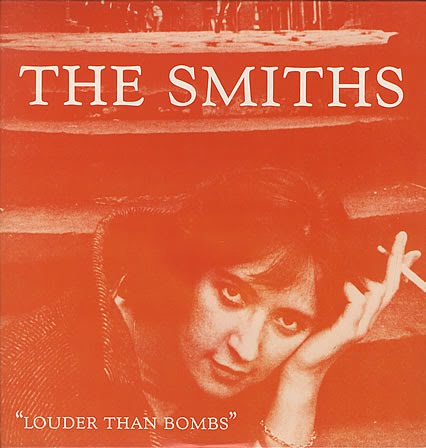
The Smiths- Louder Than Bombs (1987) MP3 & FLAC
"Because the music that they constantly play, it says nothing to me about my life."
Louder Than Bombs, originally a U.S.-only hodgepodge of stray singles, b-sides, Peel sessions, and tracks culled from both The Smiths' debut and the UK-only compilation, Hatful of Hollow, is an unwieldy, unfocused, and still somehow mostly brilliant reminder of how peerless The Smiths were in their mid-eighties heyday. The album's true riches are the singles (and their b-sides) that were not included on The Smiths' four studio albums. Chief among these is "Shoplifters of the World Unite," a bludgeoning, lo-fi paean to stepping out of the closet, which features a seductively glum vocal from Morrissey and some nice multi-layered guitar work from Johnny Marr. The b-side of this single, the brilliant "You Just Haven't Earned It Yet, Baby," while being one of the most traditionally structured rock songs The Smiths ever recorded, is a wonderfully acerbic send-up of a record exec's dismissive attitude toward promoting the band. Louder Than Bombs' finest moment is arguably "Panic," a sarcastic yet sincere indictment of the banality of commercial radio, complete with a children's chorus chanting "Hang the DJ!" If not the finest moment in The Smith's justly legendary discography, Louder Than Bombs is no less essential for it.
(La) luna Lexicon:
1980s,
Album,
Brit-Rock,
FLAC,
Jangle-Pop,
Morrissey,
MP3,
Peel Sessions,
Post-Punk,
Smiths
Monday, March 28, 2011

Fairport Convention- Live at The BBC (2007) Box Set (4 Discs) MP3 & FLAC -For Telehorse_UMA-
"The dawn will send me on a chase to nowhere. Why cry as if I were the first to go there?"
Simply put, Fairport Convention, in their late-sixties incarnation, were the best folk-rock band going British or otherwise. Not only were they adept (re)interpreters of both the British and American roots traditions, but, unlike many of their peers, they were also capable of writing fine original material. Although their best work occurred during Sandy Denny's brief but legendary stint with the band, there is, nevertheless, much fine material to discover both before and after this period. While Fairport Convention were a great studio band with several classic albums to their credit, their more impromptu, less polished BBC recordings are just as revelatory and contain many gems that never appeared on their albums. A perfect example is their stunning interpretation of Leonard Cohen's "Suzanne"; if not eclipsing the original, Sandy Denny's soaring vocals, the ominously odd shuffling tempo and the psychedelic overtones of Richard Thompson's guitar-work take the song somewhere entirely new. However, even the more familiar Fairport material fares well here. Denny's masterpiece, "Who Knows Where the Time Goes?," receives a lovely, desolate acoustic treatment that easily bests the lighter folk-rock arrangement of the studio version on Unhalfbricking. It should be noted that the sound quality is not the best in places, especially the "off-air" recordings, but the essential nature of much of the music more than makes up for this. An amazing document of some of the best British-Folk recorded during the late sixties and early seventies.
(La) luna Lexicon:
1960s,
1970s,
Album,
British Folk,
Compilation,
Fairport Convention,
FLAC,
Folk,
Folk-Rock,
MP3,
Peel Sessions,
Psychedelic,
Richard Thompson,
Sandy Denny
Friday, March 11, 2011

Gang of Four- Peel Sessions Album (1990) MP3 & FLAC
"The past lives on in your front room; the poor still weak, the rich still rule."
Presenting Gang of Four at their scratchy, blunt, and angular best, The Peel Sessions Album, comprised of three separate John Peel sessions spanning the years 1979-1981, has long had the reputation for containing some of the best performances the band ever recorded. Gang of Four virtually defined the Post-Punk ethos- a jagged, acerbic deconstruction of the Punk movement's nihilistic tendencies, and on The Peel Sessions Album, perhaps even more so than on their justly iconic debut, Entertainment!, their "agit-pop" songs are offered up unpolished and positively seething with cerebral sarcasm. Tracks such as "I Found That Essence Rare" and "5.45" exhibit a more frenzied, slightly out of control feel that is largely missing on the studio versions of these songs. For comrades already familiar with Gang of Four's work, this album is a treasure-trove of fine performances by the original lineup. For those unfamiliar with this seminal Post-Punk band, there is no better point of entry.
(La) luna Lexicon:
1970s,
1980s,
Agit-Rock,
Album,
Compilation,
FLAC,
Funk,
Gang of Four,
MP3,
New Wave,
Peel Sessions,
Post-Punk
Tuesday, March 8, 2011

The Te@rdrop Explod3s- P33L Sessions Plus (2007) MP3 & FLAC
"If you have a daughter bounce her on your knee. If you have a son send the blighter off to sea."
One of the more mercurial Post-Punk bands of the late seventies and early eighties, The Teardrop Explodes' all-too-brief career spanned only two studio albums, yet is no less legendary for that. Lead by the brilliantly eccentric Julian Cope, The Teardrop Explodes combined an angular Post-Punk foundation embellished with psychedelic and Kraut-Rock elements and was not even averse to employing brass on occasion. Given the brevity of their discography, the re-issue of the band's 1979-1982 sessions for the BBC are both a godsend and a revelation (although Peel Sessions Plus is far from being a comprehensive compilation, as there are supposedly more than a dozen different BBC sessions in the can somewhere). The October 1979 session, recorded while the band was still, more or less, unknown, is a perfect example of their unique sound, often combining atonal guitar work with neo-psychedelic overtones, which simply doesn't sound like any other band of that era. Peel Sessions Plus also serves as yet another reminder that Julian Cope is one of the most underrated vocalists of the "alt" rock-era.
(La) luna Lexicon:
1970s,
1980s,
Album,
Compilation,
FLAC,
Julian Cope,
Kraut-Rock,
MP3,
Peel Sessions,
Post-Punk,
Psychedelic,
Teardrop Explodes
Sunday, February 27, 2011

Siouxsie and the Banshees- The Scream (1978) Deluxe Edition (Bonus Disc) MP3 & FLAC -For David-
"Got to give up life in this netherworld. Gonna go up where the air is stale."
Having already gained notoriety (and in certain respects, infamy) through their early BBC sessions with tireless benefactor John Peel and with a hit single ("Hong Kong Garden"), Siouxsie and the Banshees didn't disappoint on their debut, The Scream, which, first and foremost, stands as one of the truly great albums of the British Punk movement of the late-seventies. Those more familiar with the band's later work will be shocked by the abrasive aggression on display here, but the straight ahead production (by Steve Lillywhite no less) does provide the songs plenty of room to breathe. And then, of course, there's Siouxsie, who is in fine voice throughout the album, wailing, shrieking, hiccupping, and generally creating the Goth-vocal template that went on to spawn a thousand imitators and continues to be an influence on contemporary artists such as Bat for Lashes and Zola Jesus. While its penchant for privileging dissonance over melody may conjure the ghost of The Velvet Underground a bit too frequently, The Scream is, nevertheless, essential, as it captures Siouxsie in purest form: hungry and unadorned.
(La) luna Lexicon:
1970s,
Album,
Compilation,
Creatures,
Dream Pop,
FLAC,
Gothic,
MP3,
Peel Sessions,
Post-Punk,
Punk,
Siouxsie and the Banshees,
Siouxsie Sioux,
Steve Severin
Friday, February 25, 2011

Joy Division- "Transmission" Video (1979) Live, John Peel Show
The Holy Grail of Post-Punk.
(La) luna Lexicon:
1970s,
Art-Rock,
Factory,
Joy Division,
New Order,
Peel Sessions,
Post-Punk,
Punk,
Video
Thursday, February 17, 2011

Siouxsie and the Banshees- Voices on the Air: The Peel Sessions (2006) MP3 & FLAC -For David-
"With a jaundiced wink, see his cunning slink. Oh, trust in me my pretty one."
If your frame of reference for Siouxsie and the Banshees is their "Peek-a-Boo" era goth-pop, then hearing some of these early Peel Session tracks dating back to 1977 will be a profound ear-opener. In an earlier post, I wrote that Bauhaus' debut album along with their "Bela Lugosi's Dead" single were largely responsible for the rise of the early Goth movement, but based on the evidence of these early Peel Sessions, a strong case can be made for Siouxsie Sioux having played a major role in the development of both Goth in particular and Post-Punk in general. This music is exceedingly dark, beautifully abrasive, and then there's Siouxsie's singular, unmistakable voice, a piercing call-to-arms that Punk would refuse to be easily defined. It also strikes me that this compilation is a perfect tribute to the late John Peel. The earliest of these sessions were recorded at a time when no record company would touch Siouxsie and the Banshees, and Peel was instrumental (and fearless, as he was for many bands) in getting them exposure. This is a vastly underrated chapter of the Siouxsie discography, and in many cases, the songs are often better than the studio counterparts.
(La) luna Lexicon:
1970s,
1980s,
Album,
Compilation,
Creatures,
Dream Pop,
FLAC,
Gothic,
MP3,
Peel Sessions,
Post-Punk,
Punk,
Siouxsie and the Banshees,
Siouxsie Sioux,
Steve Severin
Sunday, February 6, 2011

Cocteau Twins- Garlands (1982) MP3 & FLAC
"At the bosom or the breast, of the forehead or the fist."
Easily the darkest and most straightforwardly Post-Punk album Cocteau Twins ever recorded, Garlands has a spare, desolate, insistently minor-key sound that owes a clear debt to Joy Division; however, what keeps the proceedings from sounding derivative are Robin Guthrie's spiraling guitar textures (far more primal than on future albums) and Elizabeth Fraser's vocals, which somehow manage to evoke beauty and dread simultaneously. While the album suffers a bit from the use of a drum machine and several songs that are overly repetitious (something rarely found on their later albums), Garlands manages to create a sound that, while not indicative of where Cocteau Twins were heading next, still played an important role in defining the 4AD sound of the early 80s.
(La) luna Lexicon:
1980s,
4AD,
Album,
Cocteau Twins,
Dream Pop,
FLAC,
Gothic,
MP3,
Peel Sessions,
Post-Punk
Subscribe to:
Posts (Atom)